The artistic life of Mogens Zieler
Mogens Zieler was born in
Copenhagen in 1905, the second son of a naval officer.
He began painting as a
child. At age 13, he achieved an astoundingly mature composition in a painting
of roof tops, and since then his paint-box would always be his trusty
companion.
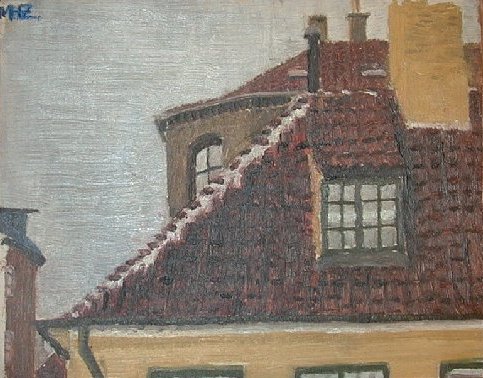
1: Roof-tops,
1918.
As you can see, the "Z", Zieler's initial and emblem, is
predominant as a constructional element in this early piece. The author C. F.
Garde pointed this out to the older Zieler, who was amused as well as astounded
at the fact.
Having completed school to his parents' satisfaction, the young
painter was free to pursue his artistic interests, and attended several art
schools, Harald Giersing's being the most important influence. Always open to
all kinds of possible sources of inspiration, this picture is based on an
Italian travel-sketch by a famous Danish poet:
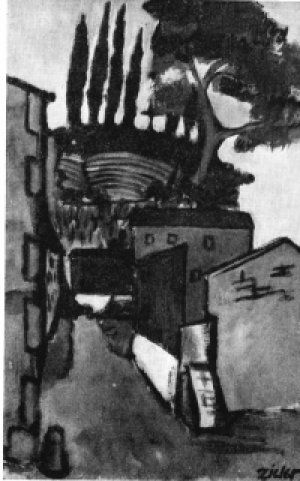
2: Fantasy based on
travel-sketch by H. C. Andersen, 1927.
Nowadays, Hans Andersen is
generally recognized as an outstanding pictorial artist. Zieler discovered this
already in 1927!
Later he was admitted to the Danish Academy of Fine Arts in
Copenhagen, studying block printing and fresco painting.
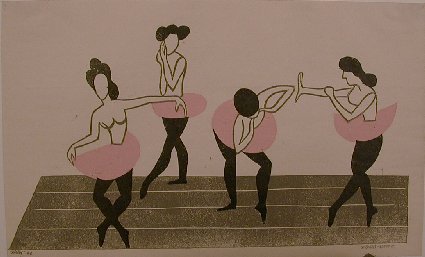
3: Ballet-scene,
1940.
Zieler's début as an artist was at the Copenhagen Artists' Fall
Exhibit in 1926. The same year he was associated with C. M. Woel's publishing
house, and thus embarked on his secondary, but unique career as a "book-artist",
which came to mean somebody who not only illustrated books, but supervised each
and every aspect of the book's production.
Authors published in Danish with
that special Zieler-"touch" include: Walt Whitman, Hans Andersen, Isak Dinesen,
F. Voltaire; but also older works like the oriental epics "Gilgamesh" and
"Sakuntala", not to mention "Arabian Nights" and the "Fables" of Aesop, fit his
talent extremely well. Here is an illustration from Aesop:

4: Sour Grapes,
1945.
Zieler married Bennie in 1930.

5: In brown, white and black,
1940.
Later the same year, the young couple traveled in Europe to view
the great masterpieces, but Zieler found the vast inspiration to have a numbing
effect on his own development as an artist.
Not that the inspiration was
wasted - it just seemed to take some years for it to "seep through", as it were,
to the accessible layers of the painter's consciousness.
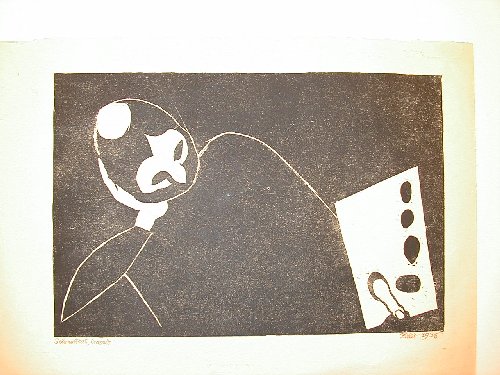
6. Self-portrait,
1936.
In 1939 the Zielers went on a grand tour to the far East, calling
at Java, Bali and Celebes.
Paradoxically, and thus typically for Zieler, the
encounter with this exotic art world proved immensely more productive for his
own artistic output. He was able to create paintings, drawings and lithographs
for decades after the journey, all looking as fresh and immediate, as if they
were done on site, only using his sketches and his formidable memory.
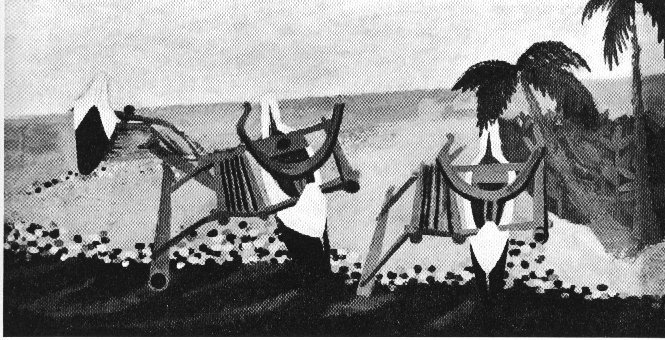
7: Fishing boats on
the coast of Celebes, 1936.
About this time, Zieler became interested in
the Great Highland Bagpipe and its music. It became an all-consuming, contagious
passion with him, which greatly influenced his life and his pictorial art -
follow the link to meet "Piper
Zieler"
These two lions and a half are from Zieler's book on lion-hunting
in Jutland. 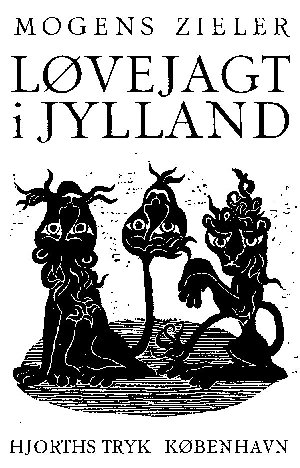
8: Two
lions and a half, 1950.
This book originated as a centerfold in one of
the Copenhagen papers in the forties. Back then, the printing process was slow
enough to allow rather accomplished colour prints to come out as beautifully as
hand-produced drawings or lithographs - to wit, this rendition of the
traditional Danish phenomenon of the lent-sun "dancing"!
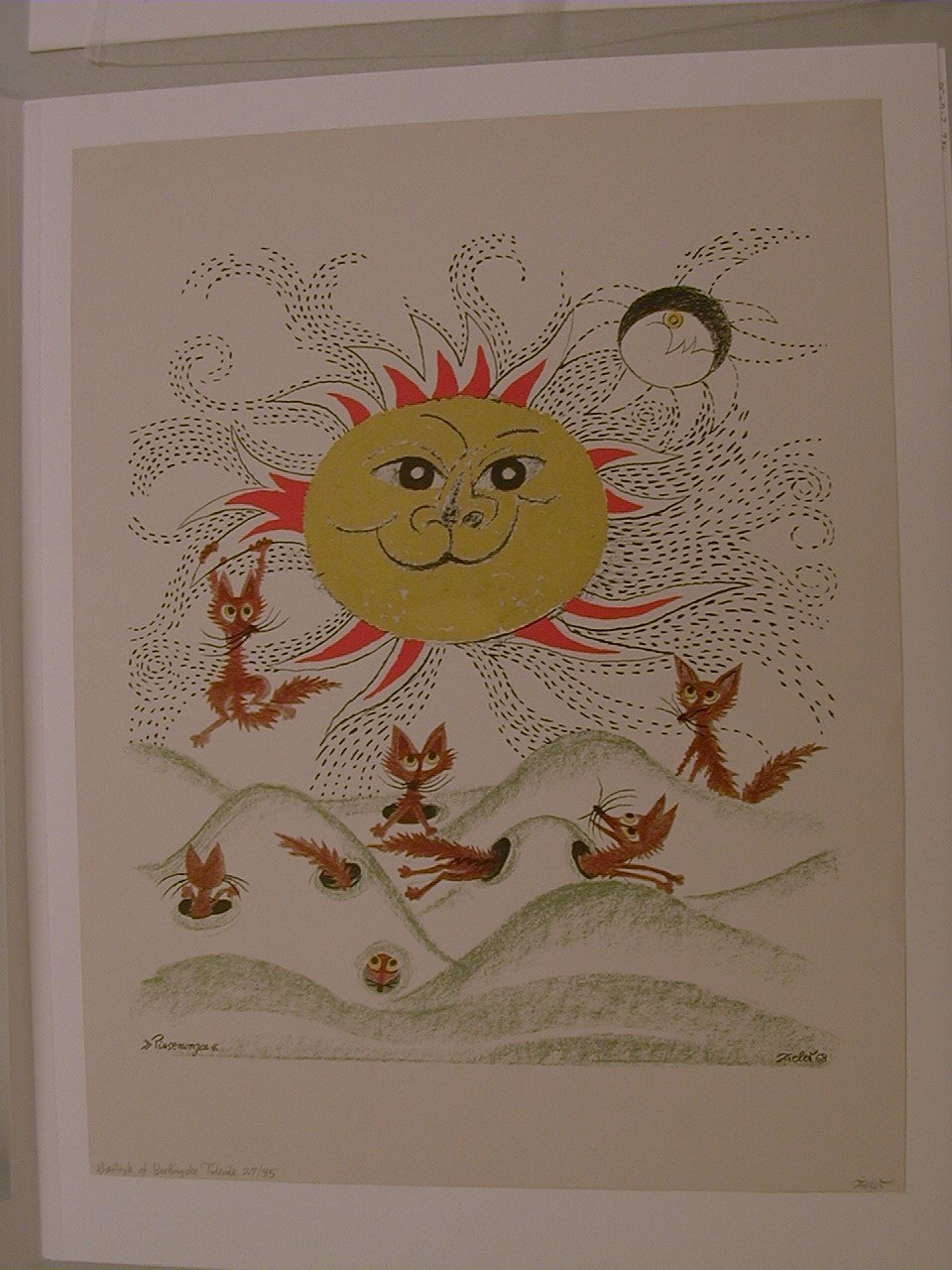
9: Lent morning.
Among the
many other interesting commissions fulfilled by Zieler, building- decorations,
interior as well as exterior, were always executed with particular zeal. This
mural promotes a certain dairy product quite eloquently, I'd say!
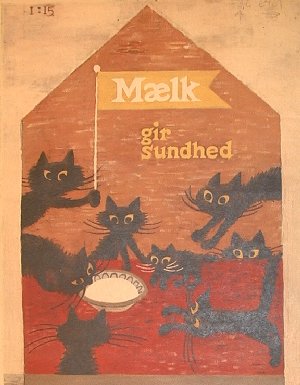
10: Breakfast's
served!
The following many years the Zielers shared their time between
the flat in Copenhagen, and a wonderful, albeit tiny, summer-studio near
Horsens.
 11: The
summer-studio.
During winter, Zieler would work at prints and
book-designing, while the summers were spent horse-riding, sketching, painting,
and providing Bennie with designs for woven pictures, which became a famous
addition to her husband's already legendary canvasses and prints.
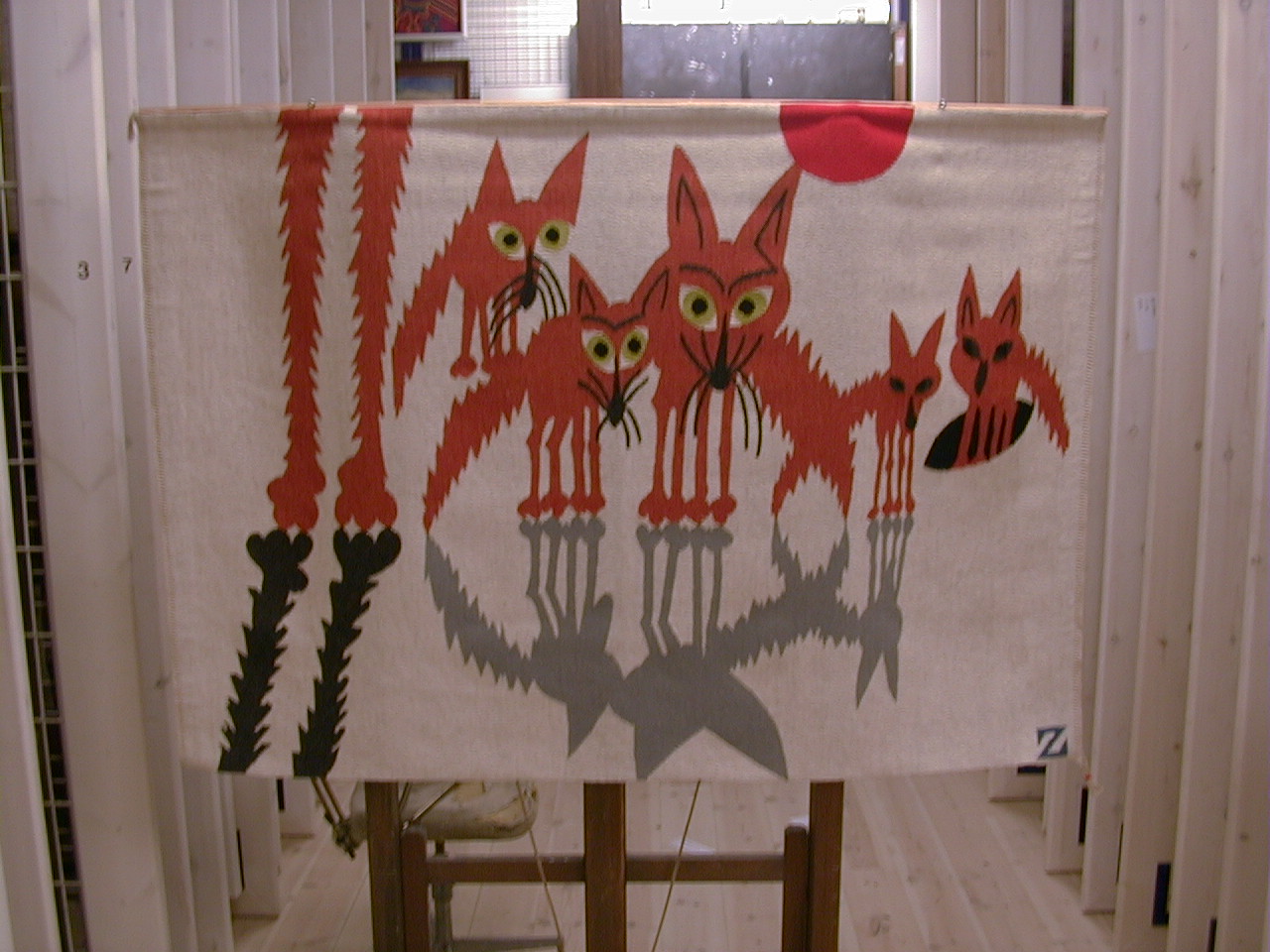
12: The fox-sun,
1969.
This amusing canvas illustrates the Zielers' co-operation:
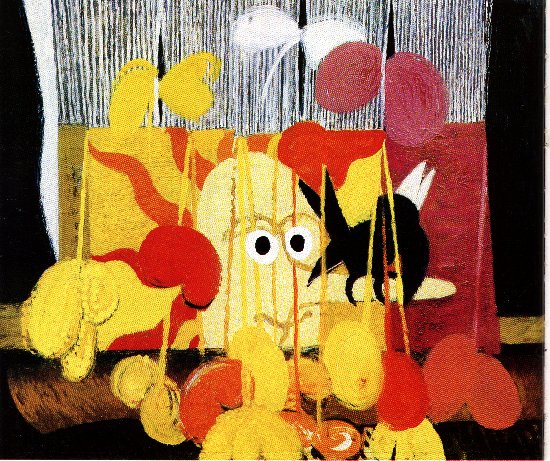
13: The sun on the
trend.
Although the sun-person emerging on the loom is supposedly
2-dimensional, the blackbird finds no difficulty in perching on his nose!
The
rolling hills and small forests of the area around Horsens provided the
inspiration for his many pictures of trees and wild-life.
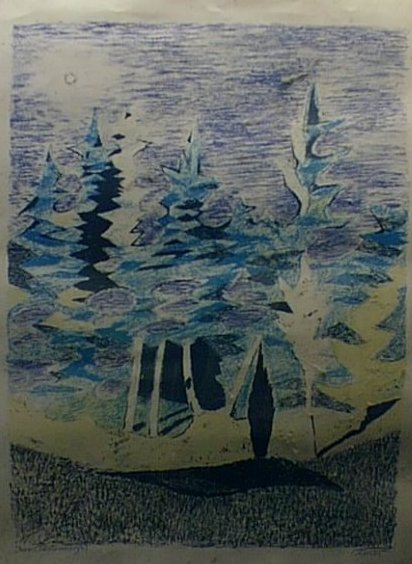
14: Forest.
Mogens Zieler lived
happily with his wife, animals and friends until well into the seventies, and
deplorably less so until he finally left us.
He was rather disenchanted with
the prospect of unavoidable death, because he had so much to live for, to learn,
to understand, and to give - he was the most generous person his friends ever
knew - on top of which he committed the hubris of setting out to prove that
happiness was mightier than sorrow, according to an interview with the
journalist C. F. Garde.
The nemesis was, that it didn't work in his own life.
He lost his wife under tragical circumstances, and with her most of his creative
powers.
He died, sick and exhausted, in 1983.
Still, he was allowed to
leave a great legacy of happiness to his devoted followers, through his
many-faceted life-work.
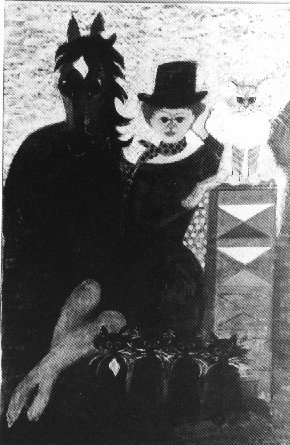
15: Family-picture, 1968.
Back to index page